
By the time you finish reading, you'll know exactly when to file, who must file, what documents to gather, how to use IRIS 2.0, and what happens if you miss the deadline....
The FBR income tax return last date for individuals and AOPs is September 30, while companies must file by December 31. First-time filers must register on IRIS 2.0, obtain an NTN, and declare income and assets through a wealth statement. Missing the deadline results in ATL exclusion and financial penalties.
Tax season in Pakistan moves fast. If you're a salaried employee, freelancer, business owner, or company director, knowing the FBR income tax return last date is not optional—it's the foundation of staying compliant with Pakistan's Federal Board of Revenue.
The 2026 tax filing period brings significant changes under the Finance Bill 2026, including revised tax slabs, new rules for digital income earners, and stronger enforcement through IRIS 2.0. Whether you're filing for the first time or looking to avoid a costly mistake this year, this guide covers every step of the process clearly and completely.
By the time you finish reading, you'll know exactly when to file, who must file, what documents to gather, how to use IRIS 2.0, and what happens if you miss the deadline.
What Is the FBR Income Tax Return?
What Is the Federal Board of Revenue (FBR)?
The Federal Board of Revenue (FBR) is Pakistan's apex tax authority, operating under the Ministry of Finance. FBR is responsible for collecting income tax, sales tax, federal excise duty, and customs duty across the country. It administers tax laws, issues regulatory notifications (SROs), maintains the Active Taxpayer List (ATL), and manages the IRIS 2.0 portal through which all income tax returns are filed.
What Is an Income Tax Return?
An income tax return is a formal declaration submitted to FBR that reports your total income earned during a tax year, along with any taxes already paid or withheld. The return also includes a wealth statement, which discloses your assets and liabilities. Pakistan's tax year runs from July 1 to June 30.
Why Tax Filing Matters in Pakistan
Filing a tax return does more than fulfill a legal obligation. It places your name on the Active Taxpayer List (ATL), which directly affects tax rates applied to your financial transactions—from bank withdrawals and property purchases to vehicle registrations and dividend income. Non-filers pay significantly higher withholding tax rates across these transactions. Filing also protects you from FBR notices, audit exposure, and penalties.
FBR Tax Return Last Date 2026
Due Date for Individuals and AOPs
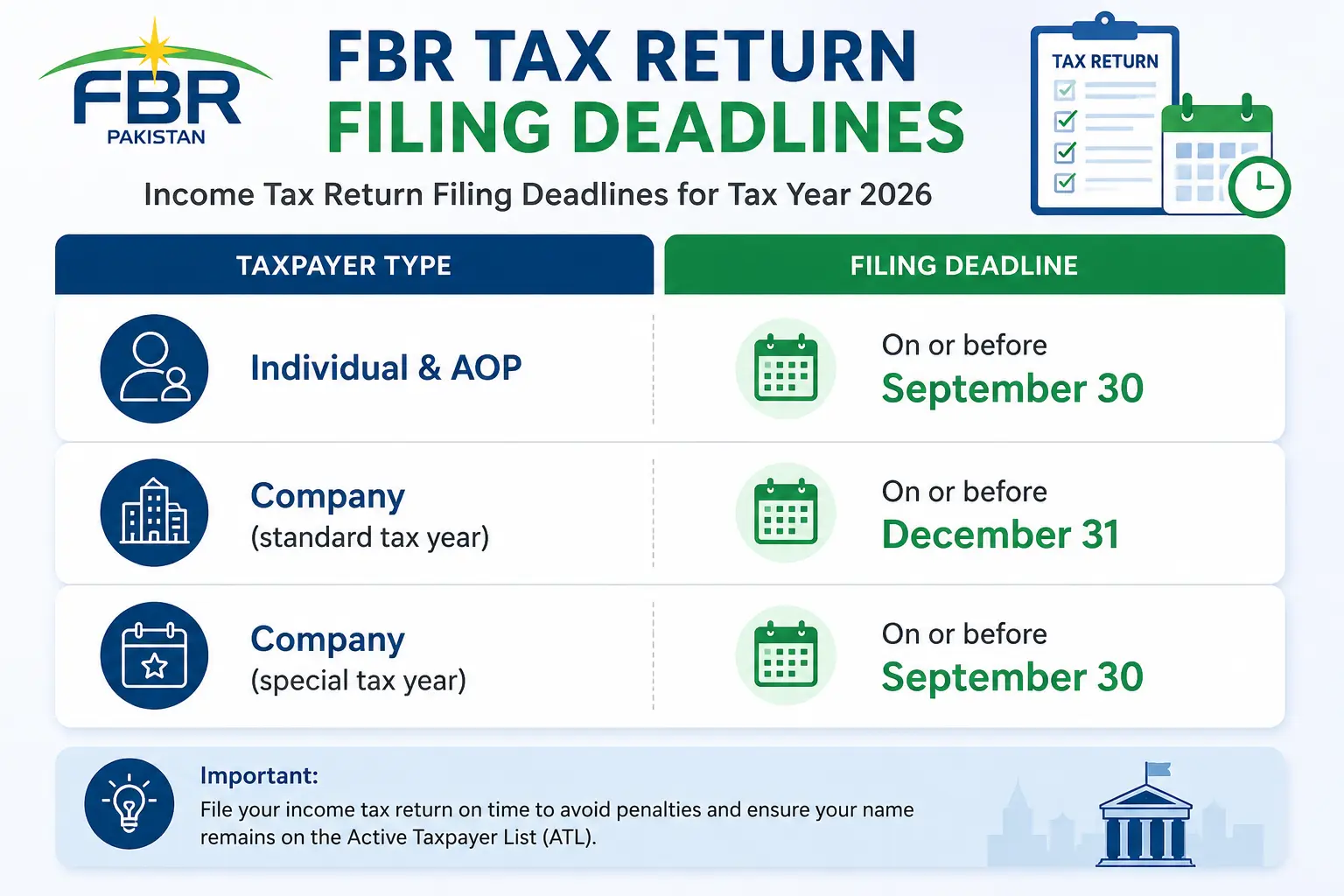
According to the official FBR income tax due dates (Federal Board of Revenue), individuals and Associations of Persons (AOPs) must file their income tax returns on or before September 30 of each year. This applies to salaried employees, freelancers, sole proprietors, and partners in an AOP.
Due Date for Companies
Companies operating under a standard tax year must file their income tax returns on or before December 31. This deadline applies to private limited companies, public companies, and other corporate entities registered under the Companies Act.
Due Date for Companies with Special Tax Years
Companies with a special tax year (i.e., a financial year ending on a date other than June 30) must file their income tax returns on or before September 30, calculated from the end of their respective tax year.
Summary Table: FBR Income Tax Return Deadlines 2026
What Happens If FBR Extends the Deadline?
FBR has historically extended filing deadlines in response to technical issues on IRIS or taxpayer demand. Extensions are announced through official FBR notifications and SROs. You can monitor these updates directly through the FinSmart FBR Notifications page, which tracks all SROs and regulatory announcements in real time. That said, relying on an extension is risky. Filing on time guarantees ATL inclusion and avoids penalties.
Who Must File an Income Tax Return in Pakistan?
Salaried Individuals
Any salaried person whose annual income exceeds PKR 600,000 is required to file an income tax return. Under Finance Bill 2026, the 0% tax threshold begins at PKR 600,000, with the highest slab of 35% applying to income exceeding PKR 7 million (revised upward from the previous PKR 4.1 million threshold, per EY Ford Rhodes analysis of Finance Bill 2026).
Freelancers and Digital Income Earners
Finance Bill 2026 introduces a 5% withholding tax on income derived from digital platforms and social media, including earnings from platforms like YouTube, Upwork, and Fiverr. For Pakistani residents, this withholding tax functions as a minimum tax that must be reconciled in the annual return. Freelancers must now file, whether or not they previously considered themselves liable.
Business Owners
All registered businesses, proprietorships, partnerships, and self-employed professionals must file annual income tax returns, regardless of whether they made a profit in the tax year.
Property Owners
Individuals who own immovable property, have purchased or sold property during the year, or earn rental income must file a tax return. Finance Bill 2026 standardizes advance tax on property transactions at 2.75% on sale and 1.25% on purchase, replacing the previous tiered structure.
Overseas Pakistanis
Pakistani nationals living abroad who earn income in Pakistan—through rent, investments, or business activities—are required to file returns. FBR's IRIS 2.0 supports e-filing for non-resident taxpayers.
Investors and Traders
Those earning income from dividends, capital gains on shares, mutual funds, or securities are also required to file. Finance Bill 2026 also increases withholding tax on debt securities from 15% to 20%.
Understanding Filer vs Non-Filer in Pakistan
What Is a Filer?
A filer is a taxpayer whose name appears on the Active Taxpayer List (ATL). To achieve filer status, you must file your income tax return by the due date and ensure your name is reflected on the ATL following its annual update.
What Is a Non-Filer?
A non-filer is any individual or entity that has not submitted an income tax return or whose name does not appear on the ATL. Non-filer status results in significantly higher withholding tax rates on a wide range of transactions.
Benefits of Becoming a Filer
Filer status reduces withholding tax rates on banking transactions, property purchases and sales, vehicle registration, dividends, and imports. Under Finance Bill 2026, higher withholding tax rates continue to apply for non-Active Taxpayers on property transactions, reinforcing the financial incentive to file on time.
Higher Taxes for Non-Filers
Non-filers face elevated withholding tax deductions at the point of transaction—at banks, property registration offices, and vehicle registration authorities. These deductions are not refundable and accumulate across every taxable event during the year.
Active Taxpayer List (ATL) Explained
What Is the ATL?
The Active Taxpayer List (ATL) is an official database maintained by FBR that lists all individuals and entities who have filed their income tax returns for the previous tax year. Appearing on the ATL directly determines the withholding tax rates applied to your transactions across the financial system.
How the ATL Works
FBR prepares and publishes the ATL annually. Banks, property registrars, and vehicle registration authorities reference the ATL to determine whether to apply filer or non-filer tax rates to a transaction.
How to Get Your Name on the ATL
To appear on the ATL, you must file your income tax return by the prescribed deadline. Late filers can also apply for ATL inclusion by paying a surcharge—the amount varies depending on your taxpayer category—after which FBR processes the inclusion request.
ATL Update Schedule
According to FBR's official website, the Active Taxpayer List (Income Tax) was last updated on July 1, 2026. The list is updated annually following the close of each tax year. You can download the latest ATL or check your active taxpayer status directly through FBR's official portal.
Documents Required for FBR Tax Return Filing
Gathering these documents before you begin your return saves time and reduces errors:
CNIC: Your Computerized National Identity Card number serves as the primary identifier for individual taxpayers
Salary Certificate or Payslips: Proof of employment income, provided by your employer
Bank Statements: Covering the full tax year (July 1 to June 30) for all accounts held
Property Documents: Title deeds, purchase/sale agreements, or rental agreements if applicable
Vehicle Information: Make, model, registration number, and purchase value of all vehicles owned
Investment Records: Mutual fund statements, share portfolio documents, savings certificates
Business Income Records: Revenue and expense documentation for self-employed individuals or business owners
How to File Your Income Tax Return on IRIS 2.0
IRIS 2.0 is FBR's official online portal for income tax return filing. It is accessible at iris.fbr.gov.pk.
Step 1: Register on IRIS
First-time filers must register on IRIS before filing. Registration requires your CNIC, mobile number, and email address. Upon successful registration, FBR assigns you a National Tax Number (NTN), which is your permanent tax identifier.
Step 2: Log In to the Portal
If you already have an NTN but have never accessed IRIS, use the E-enrollment for Registered Person option on the IRIS login page to set up your credentials. Existing users log in directly using their NTN and password.
Step 3: Complete Your Personal Information
Verify and update your personal profile, including address, employment status, and source of income. IRIS 2.0 pre-populates some fields based on data already held by FBR.
Step 4: Declare Your Income
Enter all income sources for the tax year: salary, business income, rental income, capital gains, foreign remittances, and any other taxable receipts. Finance Bill 2026 introduces mandatory structured filing formats (XML/XLSX) for enhanced data analytics by FBR.
Step 5: Submit Your Wealth Statement
The wealth statement is a mandatory component of the return for most filers. It lists all assets—property, vehicles, bank balances, investments, and business capital—alongside liabilities such as loans or mortgages.
Step 6: Pay Any Tax Due
If your return shows a tax liability after accounting for withholding taxes already deducted, you must pay the balance before submission. FBR accepts payment through authorized banking channels and the IRIS portal.
Step 7: Submit the Return
Review all entries, ensure the wealth statement reconciles correctly with your declared income, and submit the return. IRIS 2.0 generates an acknowledgment upon successful submission.
Wealth Statement Guide
What Is a Wealth Statement?
A wealth statement is a financial disclosure attached to your income tax return, showing all assets and liabilities at the close of the tax year (June 30). It is mandatory for most taxpayers above a basic income threshold and must accurately reflect your financial position.
Common Wealth Statement Errors
The most frequent mistakes include omitting jointly-owned property, forgetting to include vehicles gifted or inherited, understating cash in hand, and mismatching bank balances with statements. IRIS 2.0 flags reconciliation discrepancies before submission.
Asset Reconciliation Tips
Your net wealth increase between two consecutive years must be explained by your declared income after tax and personal expenses. Unexplained increases trigger FBR notices. Cross-check your bank statements, property valuations, and investment records before finalizing the wealth statement.
FBR Digital Invoicing and Tax Return Filing
What Is FBR Digital Invoicing?
FBR digital invoicing is an electronic system that requires businesses to generate and submit tax invoices to FBR servers in real time, replacing traditional paper-based invoicing. Under S.R.O. 709(I)/2025, digital invoicing integration is mandatory for all corporate-registered and non-corporate-registered persons notified by FBR.
Who Needs Digital Invoicing?
Businesses across sectors—FMCG, pharmaceuticals, retail, manufacturing, distribution, and e-commerce—are required to integrate their point-of-sale or ERP systems with FBR's digital invoicing infrastructure. Finance Bill 2026 further strengthens enforcement, with businesses that fail to integrate facing suspension or blacklisting of their sales tax registration.
FinSmart is a leading FBR Digital Invoicing System that helps over 500+ companies automate real-time invoice reporting, maintain compliance with evolving FBR regulations, and avoid penalties. Their FBR Digital Invoicing System for Real-Time Tax Compliance connects directly with FBR APIs for automated, instant invoice submission.
The Relationship Between Digital Invoicing and Income Tax Returns
Sales reported through digital invoicing feed directly into the data FBR uses to cross-verify income declarations on tax returns. Businesses that have their invoicing automated through systems like FinSmart can reconcile their sales tax data with income declarations far more accurately, reducing the risk of discrepancies that attract audits.
Tax Return Filing for Specific Audiences
Tax Return for Freelancers
Freelancers receiving foreign remittances must declare these earnings as income. Under Finance Bill 2026, a 5% withholding tax on digital platform income now applies, with residents reconciling this against their final tax liability. Freelancers should maintain detailed records of all platform earnings, payment receipts, and bank credits throughout the year.
Tax Return for Small Businesses and Startups
Small businesses and startups operating as sole proprietors or in partnership must file as individuals or AOPs by September 30. Business expenses—rent, salaries, utilities, and equipment—are deductible from gross income where properly documented. Finance Bill 2026 also introduces a 10% tax credit for IT and system investments, which tech-forward startups should note.
Tax Return for E-Commerce Sellers
E-commerce businesses are now subject to mandatory sales tax withholding through online marketplaces and payment intermediaries, per S.R.O. 1429(I)/2025. Sales declared through e-commerce channels must align with income declared in your annual return.
Penalties for Missing the FBR Tax Return Deadline
Late Filing Consequences
Filing after the due date without an extension triggers penalties under Section 182 of the Income Tax Ordinance 2001. Late filers also lose the right to appear on the ATL for the relevant tax year without paying an additional surcharge.
ATL Exclusion Impact
Missing the ATL means every financial transaction—bank withdrawals, property dealings, car purchases, and dividends—attracts the higher non-filer withholding tax rate for the entire year. The cumulative cost far exceeds the effort of filing on time.
FBR Notices and Audits
Late or non-filers face a higher probability of receiving FBR notices under section 114, 116, or 122 of the Income Tax Ordinance. Finance Bill 2026 introduces algorithmic and faceless audit processes, increasing the probability that anomalies are detected automatically.
How to File After the Deadline
Late filing is still accepted through IRIS 2.0. You must file the return, pay any outstanding tax liability, and then apply for ATL inclusion by paying the applicable surcharge. ATL status is restored only after FBR processes and approves the application.
Common Tax Return Filing Mistakes to Avoid
Incorrect income declaration: Omitting freelance income, rental income, or dividend income is one of the most common triggers for FBR notices
Missing assets in the wealth statement: Every asset—including jointly held property, vehicles, and foreign accounts—must be declared
Wrong bank information: Incorrect IBAN or account details delay tax refunds and create reconciliation issues
Ignoring the wealth statement: Submitting a return without a wealth statement, or submitting one with unexplained discrepancies, exposes you to assessments
How to Check Your Filer Status in Pakistan
Check Through the ATL Portal
Visit the FBR official website and navigate to the Active Taxpayer List (ATL) section to download the latest list or search by NTN.
Check Through SMS
Send your CNIC number to 9966 via SMS. FBR's system returns a message confirming whether you are an active taxpayer.
Check Through IRIS 2.0
Log in to your IRIS account and review your taxpayer profile dashboard, which reflects your current ATL status.
Tax Saving Tips for Pakistani Taxpayers
Salary Tax Planning
Ensure your employer has deducted the correct amount of withholding tax from your salary throughout the year. If excess tax was withheld, you are entitled to a refund—claim it through your return.
Business Expense Deductions
Business owners and freelancers can reduce taxable income by deducting legitimate business expenses: rent, internet, professional services, and equipment depreciation. Every deduction must be supported by receipts and documentary evidence.
Record Keeping Best Practices
Maintain bank statements, invoices, rental agreements, and investment records for at least six years—the period during which FBR can raise an assessment for any tax year. Good recordkeeping is your strongest defense in the event of an audit.
File Before the Deadline—Every Year
The FBR income tax return last date is not just a calendar entry. Missing it costs money, limits financial access, and increases audit risk—year after year. The good news is that Pakistan's tax filing infrastructure has improved substantially. IRIS 2.0 makes online filing straightforward, the ATL check process takes seconds, and digital invoicing platforms like FinSmart help businesses automate the compliance burden entirely.
Start gathering your documents now. Register on IRIS if you haven't already. And if your business needs to stay compliant with FBR's digital invoicing requirements, explore FinSmart's FBR Digital Invoicing System to keep your sales reporting accurate and audit-ready.
Stay up to date with the latest FBR SROs and regulatory changes through the FinSmart FBR Notifications page—because in tax compliance, what you don't know can cost you.
Frequently Asked Questions About FBR Income Tax Return Filing
What is the FBR income tax return last date for individuals in 2026?
The FBR income tax return last date for individuals and AOPs is September 30. This is the standard annual deadline set by the Federal Board of Revenue for all individual taxpayers and Associations of Persons in Pakistan.
What is the FBR income tax return deadline for companies in 2026?
Companies with a standard tax year must file their income tax return on or before December 31. Companies with a special tax year must file by September 30, calculated from the end of their respective financial year.
What is IRIS 2.0 and how do I use it to file my tax return?
IRIS 2.0 is the FBR's official online portal for filing income tax returns in Pakistan. First-time filers must register on IRIS to obtain an NTN. Existing taxpayers log in using their NTN and password, then complete their income declaration, wealth statement, and tax payment before submitting the return.
Who must file an income tax return in Pakistan?
Any individual with annual income exceeding PKR 600,000, business owners, freelancers, property owners, investors, and companies must file. Finance Bill 2026 also requires digital income earners—including social media creators and freelancers on digital platforms—to file as a 5% withholding tax on digital income now applies.
What happens if I miss the FBR tax return deadline?
Missing the deadline results in exclusion from the Active Taxpayer List (ATL), financial penalties under Section 182 of the Income Tax Ordinance, and increased withholding tax rates across all financial transactions for the year. Late filing is still possible through IRIS 2.0, but ATL reinstatement requires paying a surcharge.
How do I get my name on the FBR Active Taxpayer List (ATL)?
File your income tax return by the September 30 deadline. FBR updates the ATL annually—the most recent update was July 1, 2026. If you missed the deadline, you can apply for ATL inclusion by paying a surcharge after filing your late return.
What is the NTN and how do I get one?
The National Tax Number (NTN) is your unique tax identifier assigned by FBR upon registration. First-time filers receive an NTN when they register on IRIS 2.0 using their CNIC and contact information.
Is digital invoicing related to income tax return filing?
Digital invoicing, mandatory under S.R.O. 709(I)/2025 for corporate and non-corporate registered persons, governs real-time sales tax reporting. The sales data submitted through digital invoicing systems like FinSmart is cross-referenced by FBR against income declared in annual tax returns, so alignment between the two is essential for compliance.